
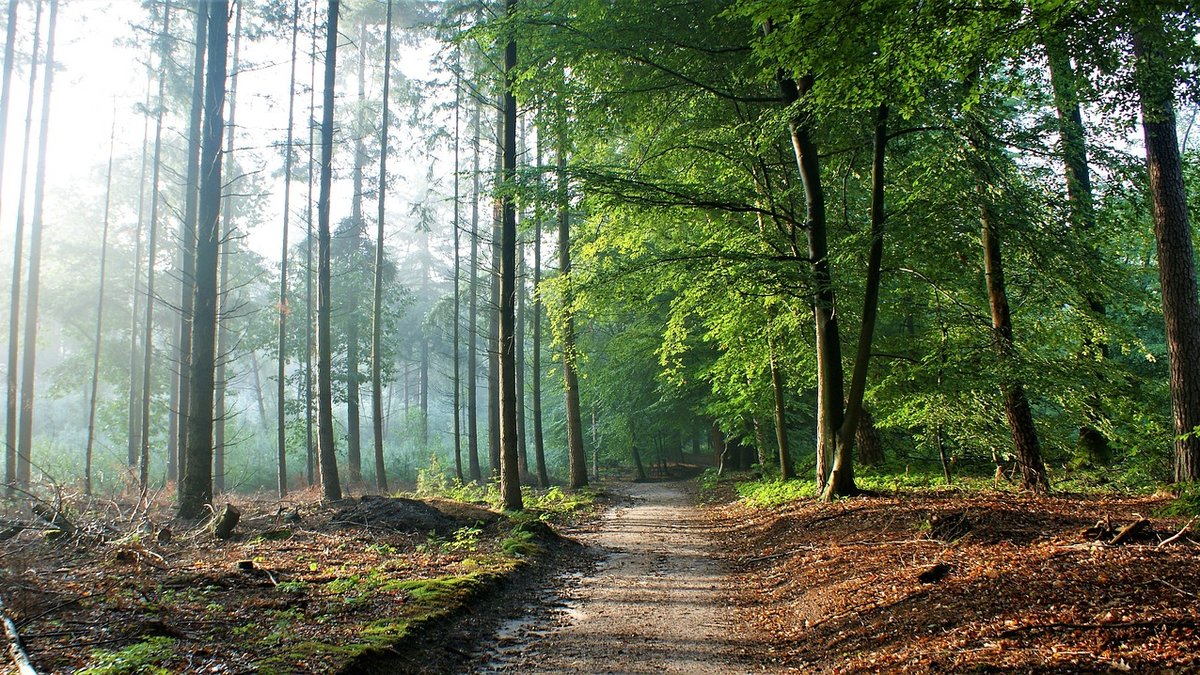
Anyone who has walked a riverbank at six in the morning knows the difference. The wind has not yet got up, the water sits flat and dark, and everything above it — willow, church tower, a heron mid-stride — is repeated below in near-perfect symmetry. By nine o'clock a breeze has textured the surface and the spell is broken. If you want clean reflections and soft mist, you have to be there early, and you have to be there deliberately.
The good news is that early starts are rarely wasted in Britain. Cool air over warmer water in autumn and early spring produces mist that drifts in ribbons rather than one flat sheet, and low sun rakes across the surface at a shallow angle, giving contrast without burning out the highlights. It is also, quite simply, quieter. Fewer dogs, fewer cyclists, fewer people who stop in the middle of a footpath to take a phone call.
This guide is aimed at walkers who carry a camera — anything from a phone to a full frame — and who would rather come home with two good frames and muddy boots than fifty average ones.
Not every stretch of every river works in the same conditions. Slow, lowland rivers with grassy banks and overhanging trees give you the classic mirror image. Fast upland rivers such as the Dart, the Wharfe or the upper Wye are better for movement — set against a still pool just below a weir, the contrast of rushing water and perfect reflection is hard to beat.
A tripod is the single most useful item, and it does not need to be expensive — it needs to be light enough that you actually carry it. Riverbanks are uneven, so look for one with independent leg angles and a hook underneath for hanging your bag as ballast.
Beyond that, a few small things make a large difference:
Still water reflects perfectly on its own, so a slow shutter is not strictly necessary — but it is transformative when there is any movement at all. At around half a second to two seconds, gentle ripples smooth into a soft, even sheen and the reflection becomes more solid than the water it sits on. Push to four or eight seconds and drifting mist on the surface turns into a pale, silky blur while the reflected trees stay sharp.
Two practical cautions. First, in bright conditions you will need an ND filter to reach those speeds at a sensible aperture — f/8 to f/11 is usually the sweet spot for depth of field and lens sharpness. Second, watch what is moving. A swan gliding through a long exposure will vanish; a swan photographed at 1/250th will not. Decide which picture you are making before you commit.
Focus carefully. Reflections sit at a different distance from the object, and autofocus can hunt on flat water. Manual focus at a hyperfocal distance, or focus on the bank and switch to manual, is more reliable.
Get low. Kneeling at the waterline, or resting the camera on a bridge parapet or a wooden jetty edge, brings the reflection forward and makes the water a foreground rather than a strip along the bottom of the frame. Look for a small anchor: a single half-submerged stone, a fallen branch, a mooring post. Reflections are beautiful but they can be empty, and one solid object gives the eye somewhere to rest.
Shoot into the light for silver water and dark silhouettes; shoot away from it for soft blues and pastel mist. Vertical compositions suit tall poplars and church spires, horizontal ones suit sweeping meanders and low mist. And do not forget to put the camera down entirely for a few minutes — the walk is the point.
Early mornings belong to wildlife. Kingfishers, herons and otters are most active in the first hour, and graceful behaviour matters more than a photograph. Keep your distance, avoid flash, and keep dogs out of the water between late autumn and spring, when gravel beds are being used for spawning and a single disturbance can undo a season's work.
Close gates behind you, use stiles and kissing gates rather than climbing fences, take every piece of litter home, and give livestock a wide berth — especially cows with calves at foot. If you are walking alone on a remote stretch, tell someone your route and rough timing.
Do all that, and you will find that the reward is not only the photographs. A river at first light has a stillness that settles on the walker as much as on the water, and it is free to anyone prepared to set an early alarm and put one foot in front of the other.

Hi, my name is Anthony kuber. I am artist and fashion designer.
I love to travel and writing blogging.
Your email address will not be published. Required fields are marked *
Software Developer & Writer
Hey, I'm Diva, a developer and writer blending code and creativity. I'm driven by a deep curiosity and a relentless pursuit of excellence. Join me as I craft digital solutions and captivating stories.


